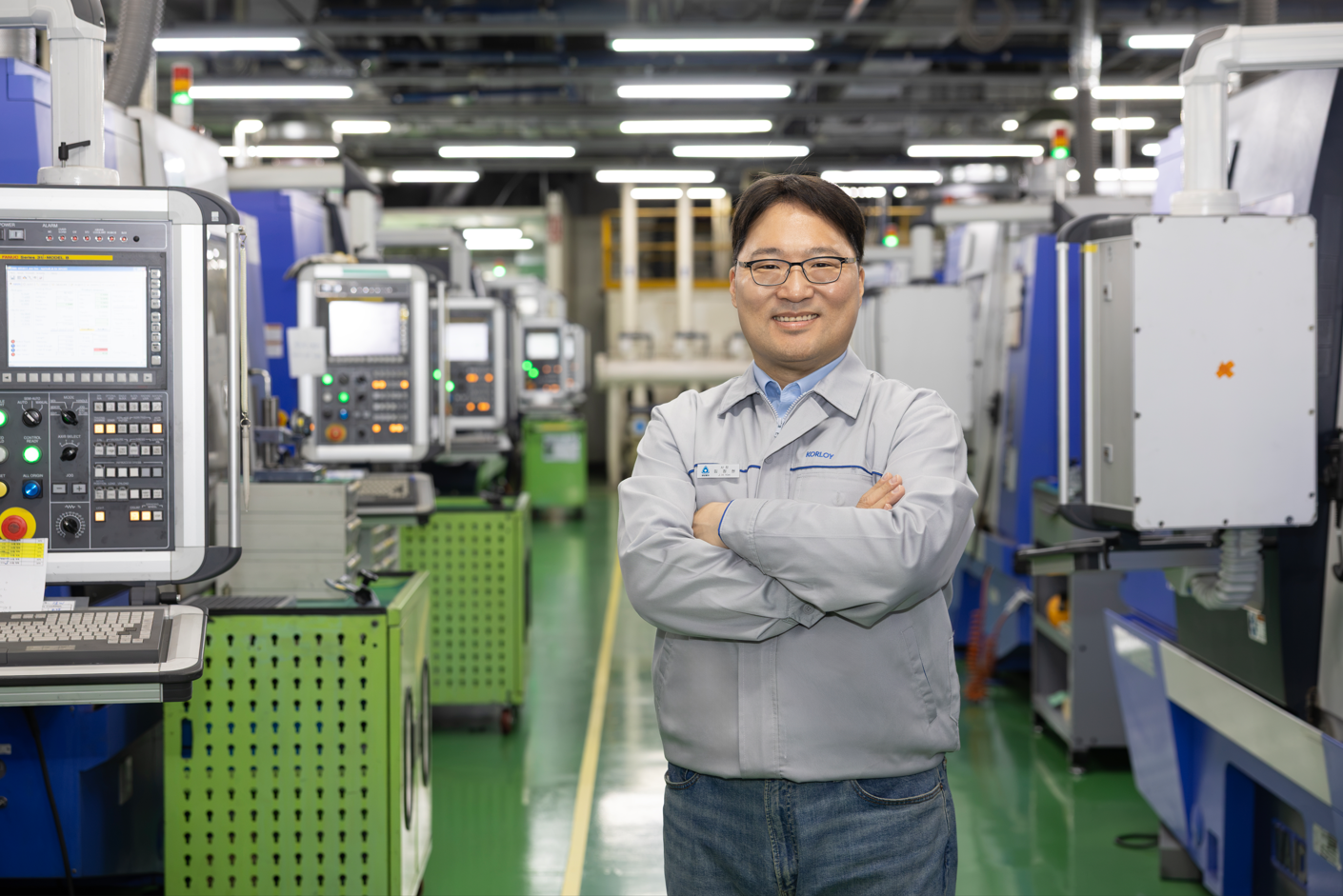


KORLOY’s Manufacturing Competitiveness Driven by Data and Smart Manufacturing – Quality Is Perfected on the Production Floor
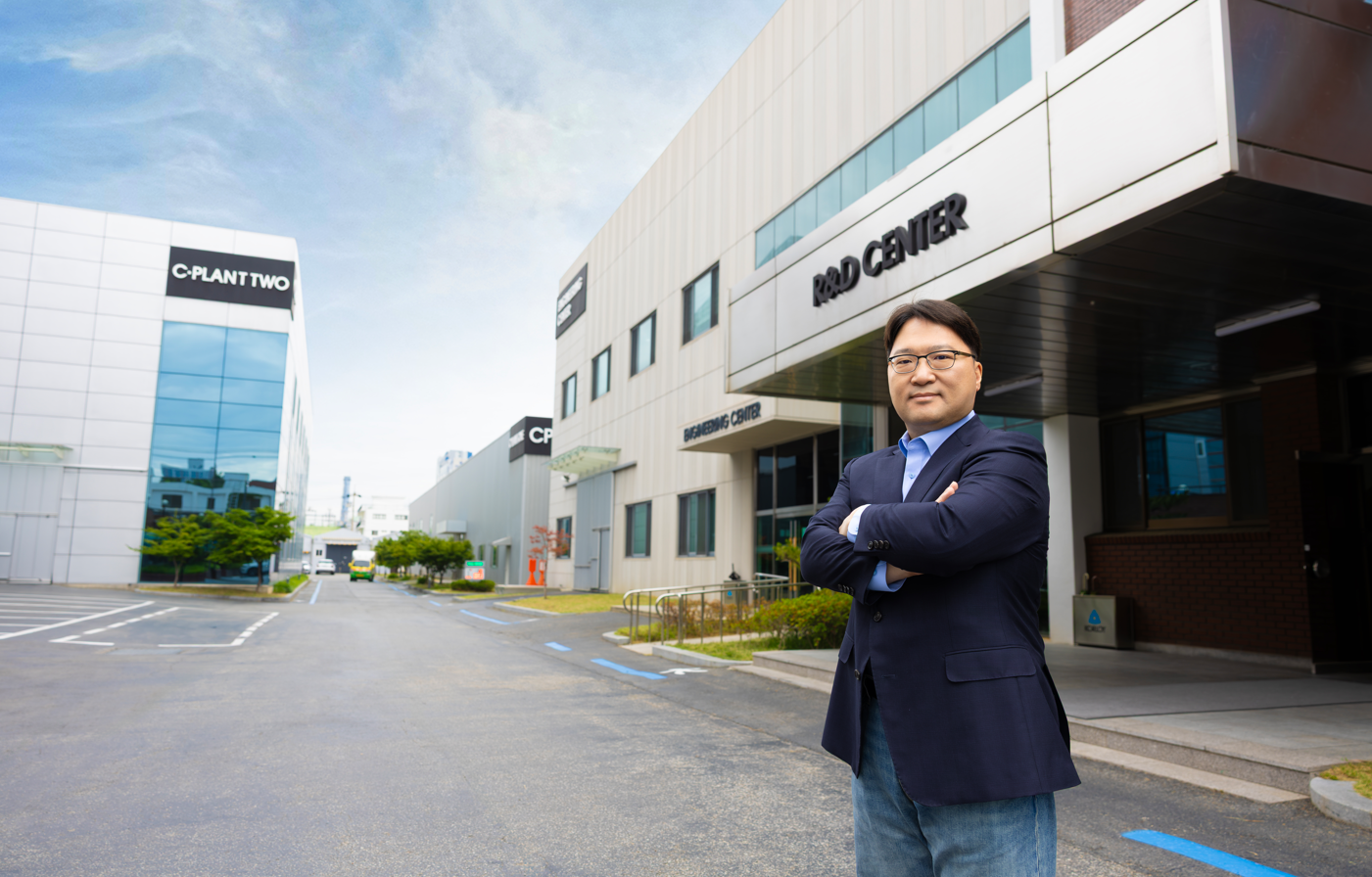
In the cutting tool industry, competitiveness is no longer determined by superior product technology alone. While carbide materials, coating technologies, and precision tool design determine product performance, it is the production system capable of consistently delivering that performance at the same high level of quality that ultimately defines a company’s competitiveness. No matter how advanced the technology may be, maintaining competitiveness in the global market is difficult without a production system that can reliably implement it and consistently reproduce the same level of quality. This is particularly true in industries that demand high levels of precision and reliability, such as automotive, aerospace, semiconductor, and mold & die manufacturing, where even the slightest variation in quality can directly affect customer productivity. As a result, the production system itself has become a key measure of corporate competitiveness.
Marking its 60th anniversary, KORLOY is taking its global competitiveness to the next level by combining six decades of accumulated cutting tool expertise with data-driven production systems and smart manufacturing innovation. Across its production sites, KORLOY is shifting from manufacturing methods that rely on human experience to a data-centric approach. Through process automation, smart logistics, and AI-based quality inspection, KORLOY is building a production system designed to simultaneously improve Quality, Cost, and Delivery (QCD).
This article explores the key initiatives behind KORLOY’s production innovation and examines the foundations of its global manufacturing competitiveness.
An Optimized Production System Powered by Two Manufacturing Hubs
KORLOY’s production system is centered around two key manufacturing hubs: the Cheongju Plant and the Jincheon Plant. Rather than producing the same products, the two plants have clearly defined roles designed to maximize overall production efficiency.
The Cheongju Plant serves as a production hub for a wide range of cutting tools, including end mills, drills, and tool holders, with particular strengths in high-mix, low-volume production and customized solutions. With a flexible production system capable of manufacturing a diverse range of products, the plant plays a key role in responding rapidly to market changes and evolving customer requirements.
In contrast, the Jincheon Plant is a core manufacturing base focused primarily on carbide and cermet inserts, as well as coated inserts. It operates an integrated production system encompassing the entire process from carbide material production to forming, machining, and coating. By managing everything from raw materials to finished products within a single production flow, the plant achieves both high quality consistency and production efficiency.
The two plants do more than simply divide production by product category. Their roles are strategically differentiated according to their respective production methods and characteristics. This structure provides an important foundation not only for strengthening KORLOY’s production capabilities but also for enhancing its responsiveness to changing market conditions.
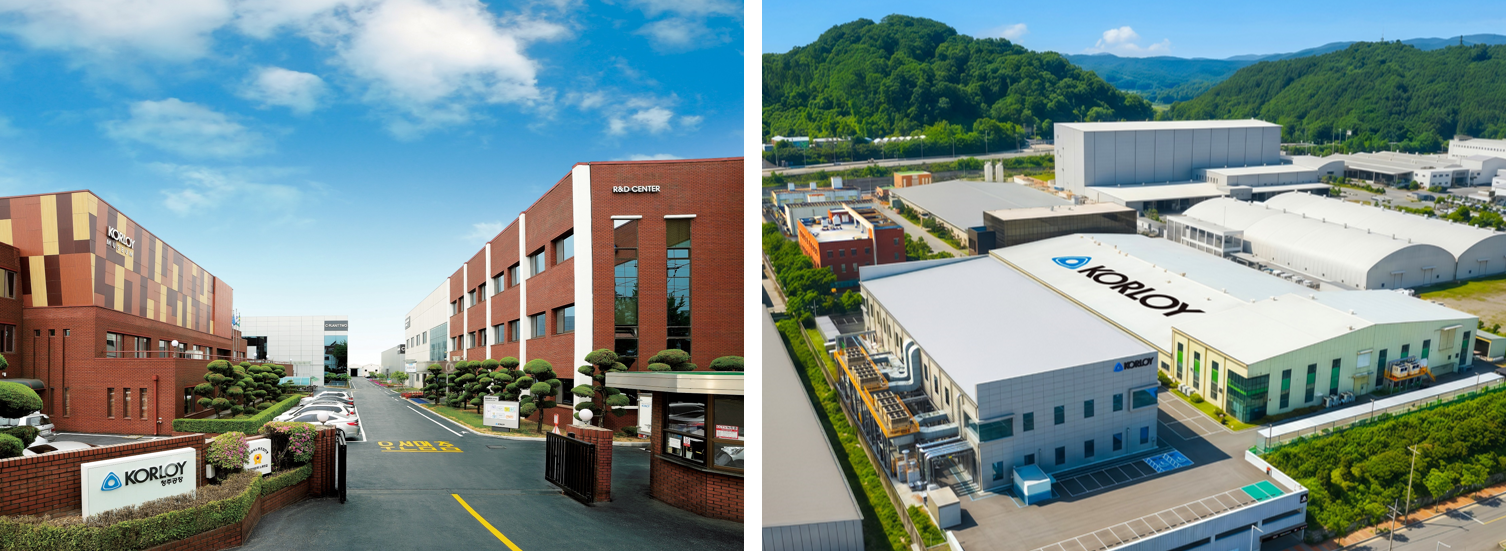
(Left) KORLOY Cheongju Plant, (Right) KORLOY Jincheon Plant
Data Is at the Core of Manufacturing Competitiveness
While many manufacturing companies highlight automated equipment as a source of competitiveness, KORLOY emphasizes that the true key to manufacturing competitiveness lies not in automation itself, but in data.
KORLOY has established a production DX (Data Transformation) system that collects and analyzes data generated across its production equipment in real time, enabling data-driven management throughout the entire manufacturing process. By leveraging a wide range of data generated during production, KORLOY is shifting production-related decision-making from reliance on human experience and intuition to a data-centric approach. This transformation helps minimize quality variations and establish a stable and reliable production system.
The benefits of data-driven production extend far beyond quality improvement. Greater process visibility and production predictability enable KORLOY to meet customer delivery requirements with greater accuracy. Combined with ongoing cost reduction (CR) initiatives across its production sites, this approach also provides a foundation for maintaining a globally competitive cost structure.
Managing production data in real time means far more than simply monitoring production status. It involves analyzing equipment conditions, process flows, and material supply to establish a system capable of anticipating and addressing potential issues before they arise during production. Ultimately, the goal of production DX is not simply to accumulate more data, but to realize “Predictable Manufacturing.”
Production Innovation Driven by the Expansion of Machining Building 2
Machining Building 2 at KORLOY’s Jincheon Plant, completed last year, represents far more than a simple expansion of production space.
In the existing production line, precision grinding, mold manufacturing, inspection, and packaging processes were all carried out within a single space, leaving room for improvement in terms of workflow and operational efficiency between processes. To address this, KORLOY separated mold manufacturing and inspection & packaging into dedicated production areas and redesigned the layout to suit the specific characteristics of each process.
These changes have made the overall production flow simpler and more efficient. By rearranging equipment, KORLOY has minimized material movement and reduced interference between processes, resulting in shorter production lead times and greater quality consistency. Enhanced specialization within each process has also improved the level of work standardization, further strengthening KORLOY’s ability to meet customer delivery requirements.
In particular, Machining Building 2 is further strengthening KORLOY’s capabilities in high-precision mold manufacturing, which forms the foundation of product quality. As the precision of cutting tools begins with the quality of the molds used to manufacture them, the ability to produce high-quality molds directly translates into greater product competitiveness. In addition, the specialization of inspection and packaging functions is further enhancing the quality of products delivered to customers.
A Smart Logistics System Connecting Production Facilities
A smart factory cannot be achieved simply by automating individual pieces of equipment. A single cutting tool must pass through numerous processes before it is completed, and productivity ultimately depends on how seamlessly these processes are connected. This is precisely why KORLOY is focusing on logistics automation—to optimize the production flow itself.
To achieve this, KORLOY recently established the Over Bridge, an overhead automated logistics system connecting its production buildings. The system automatically transfers materials required for production to the next process and has become a key infrastructure that connects the entire manufacturing facility into one continuous production flow.
Previously, materials were transported primarily by forklift. This approach required considerable operator travel time and repetitive transportation tasks, while also creating the potential for waiting time between processes and safety-related issues.
Since the introduction of the Over Bridge, human-centered material handling has been transformed into an automated logistics system, significantly improving the speed and reliability of material supply between processes. Materials can now be delivered where they are needed at the right time, while unnecessary movement and waiting time have been reduced, resulting in greater overall productivity.
Logistics automation also plays an important role in improving quality. Materials that could previously be exposed to external conditions can now be transported in a controlled and stable manner through the automated transfer system, minimizing the effects of environmental factors such as temperature and humidity. In addition, by establishing a real-time logistics management system integrating WMS (Warehouse Management System) and MFC (Material Flow Control), KORLOY is able to manage production inventory more efficiently while significantly strengthening its ability to meet customer delivery requirements.
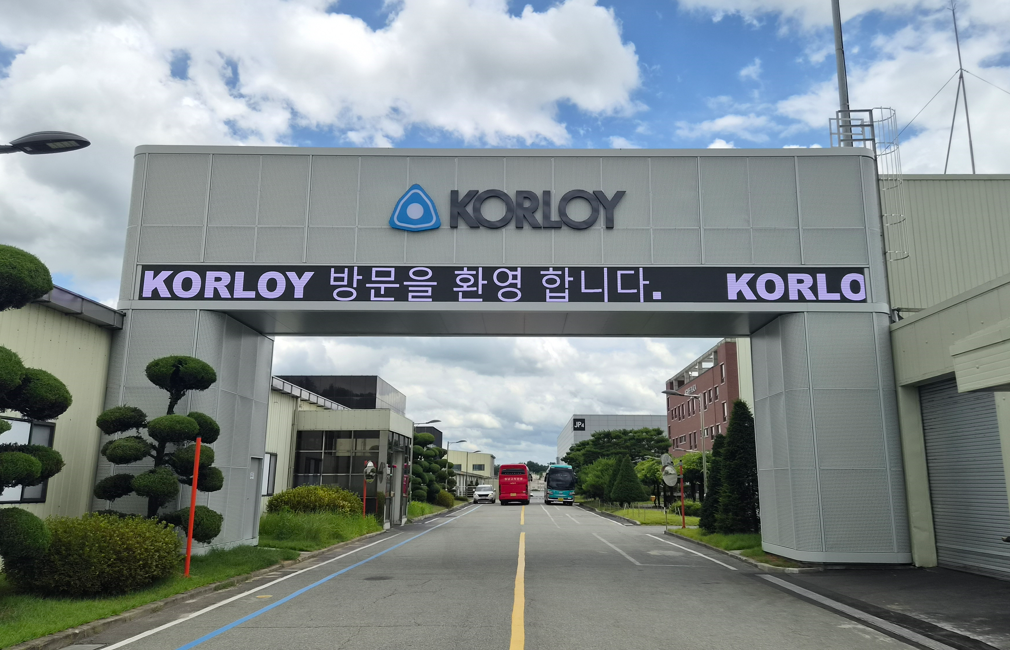
Over Bridge at KORLOY’s Jincheon Plant
AI and Automation Shaping the Future of Manufacturing
KORLOY’s approach to automation goes beyond simply replacing manual work. Its ultimate goal is to establish an intelligent production system in which people and systems work together seamlessly.
Across its production lines, KORLOY continues to expand the AGV-based automated logistics system that it has operated for many years. More recently, additional automation equipment was introduced alongside the expansion of Machining Building 2, further improving logistics efficiency. Going forward, KORLOY plans to gradually establish an unmanned logistics system integrating Autonomous Mobile Robots (AMRs) with automated warehouses.
Smart technologies are also being actively applied to quality control. Automated inspection systems using machine vision and AI-based deep learning technology automatically inspect product shape and orientation as well as detect mixed or incorrect parts. By transforming inspection methods that previously relied on human experience into a data-driven approach, KORLOY is improving both inspection accuracy and consistency. Inspection algorithms are also being continuously advanced in line with customer quality requirements.
The significance of this transformation goes beyond simply increasing inspection speed. KORLOY is evolving from a conventional approach of identifying defects after they occur toward a preventive quality management system designed to minimize defects at the source.
Production equipment is also evolving rapidly. By applying automatic feeding and unloading systems, KORLOY has converted most of its previously manual equipment into systems capable of automated operation, significantly improving equipment utilization and productivity.
Particularly noteworthy is the industry’s first automatic mold change system for carbide production. This next-generation press automation technology is designed to automatically change molds when switching production items, eliminating the need for operators to perform mold changes manually. By automating the entire process from material feeding to mold changing, the system can significantly extend unmanned operating hours even in high-mix production environments. It is expected to become one of the core technologies representing KORLOY’s smart factory in the future.
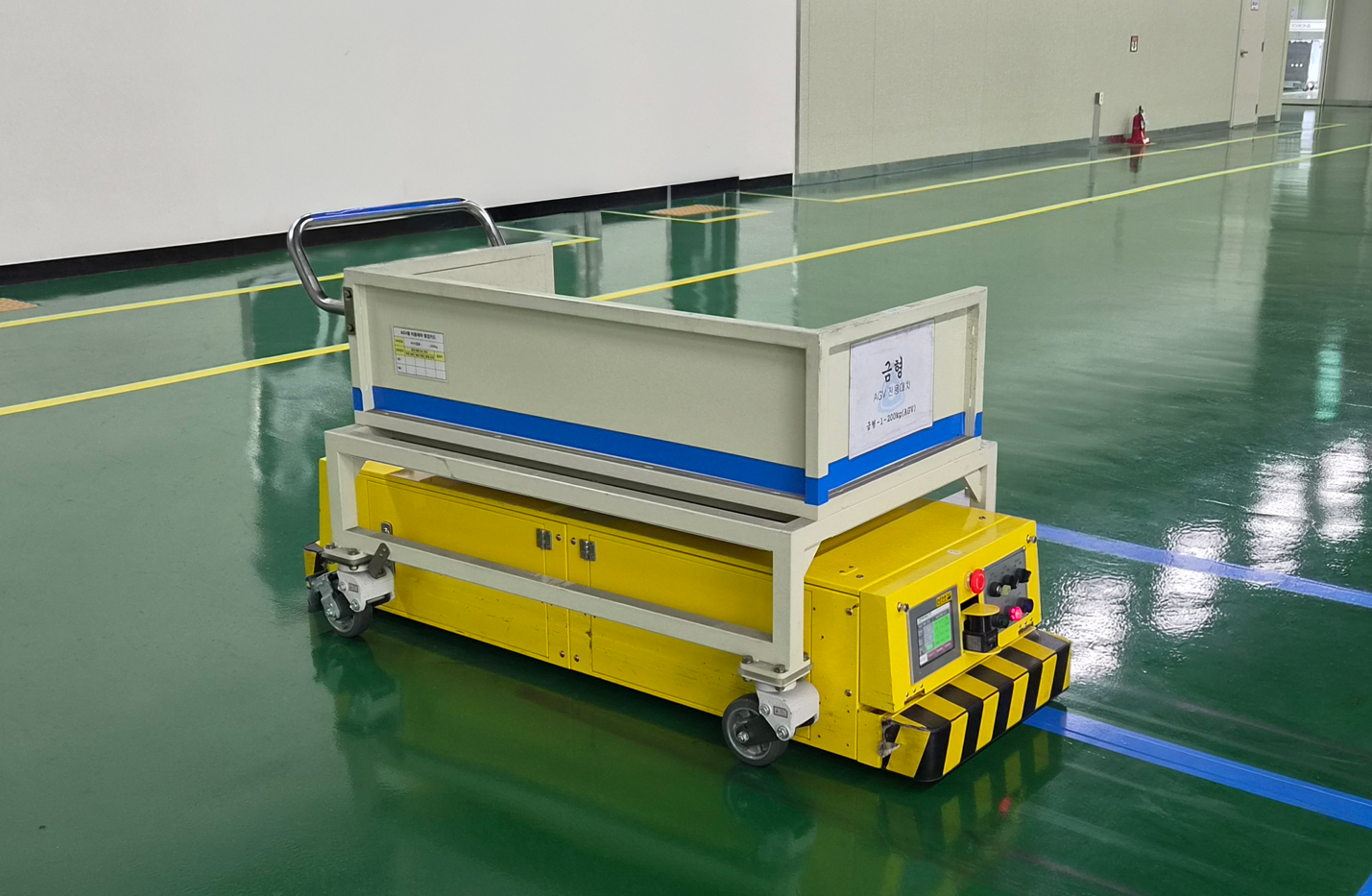
KORLOY’s AGV-Based Automated Logistics System
The Next Step in Smart Manufacturing: ‘Zero Touch Logistics’
The future production environment envisioned by KORLOY is not a “factory without people.” Rather, it is a production system designed to free employees from repetitive transportation and simple tasks, enabling them to focus on work that creates greater added value.
To achieve this vision, KORLOY is continuously advancing its smart manufacturing capabilities with the goal of realizing “Zero Touch Logistics.” The objective is to establish a fully automated logistics system in which required materials are automatically released from automated warehouses according to production plans and then delivered to each production facility by Autonomous Mobile Robots (AMRs). KORLOY also plans to further enhance its production DX and PLM systems, which integrate and manage production data in real time, to establish a globally competitive production operating system that simultaneously improves Quality, Cost, and Delivery (QCD).
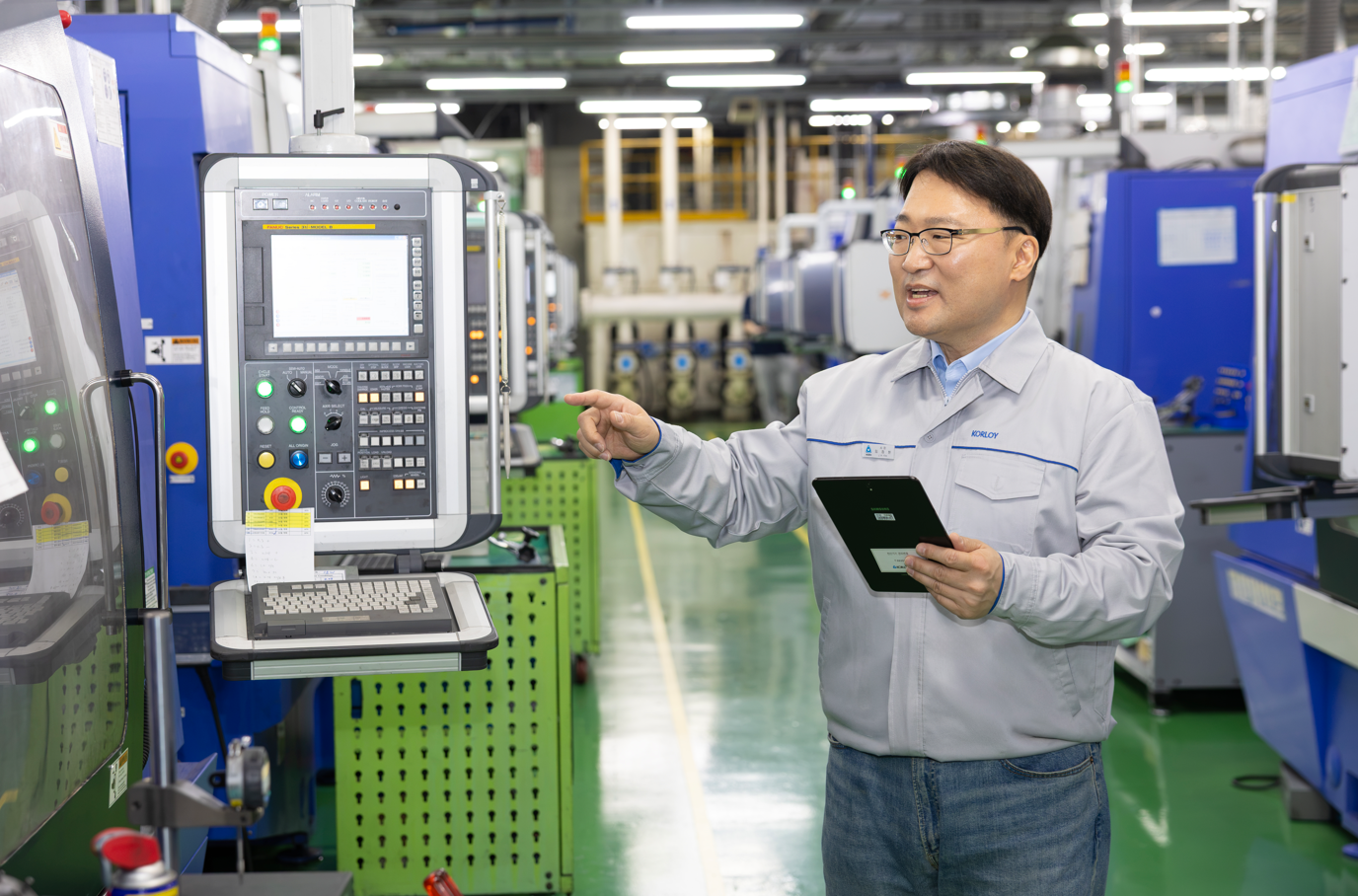
CEO JUNGHYUN YIM stated that KORLOY will continue to
advance production DX while expanding automation and unmanned operations.
The Ultimate Goal of Production Innovation: Customer Trust
KORLOY’s production innovation is not aimed simply at increasing the number of automated systems or expanding production volume. The key is to establish a production system that can consistently deliver the quality, cost, and delivery performance customers require, while ensuring the same level of performance and quality whenever an order is placed.
To achieve this, KORLOY is connecting the entire process—from product planning and design to production and quality management—into a single data flow based on its production DX and PLM systems. By managing process and inspection data in real time, KORLOY can quickly identify the causes of quality issues, while systematic management of production history enables the company to respond accurately to process changes and customer requirements.
This data-driven production system enhances not only quality consistency but also cost competitiveness and delivery responsiveness. KORLOY is also moving beyond quality management centered on post-production inspection by strengthening a preventive quality management system designed to eliminate defects and the risk of product mix-ups before they occur. Through this approach, KORLOY is delivering defect-free products and a stable supply that customers can trust.
KORLOY emphasizes that the essence of manufacturing competitiveness ultimately lies not in automation, but in customer trust. “Manufacturing competitiveness is not determined by how much automated equipment has been installed, but by how consistently a company can deliver the quality, cost, and delivery performance required by customers. Advancing production DX, automation, and quality management ultimately serves the same purpose: ensuring that customers can trust the same level of quality and reliable delivery whenever they place an order. Quality, cost, and delivery are not achieved separately; they are realized together within a single production system.”
Going forward, KORLOY plans to further advance its production operating system with the goal of achieving world-class QCD (Quality, Cost, Delivery) competitiveness. While continuing to refine its data-driven production system, KORLOY will expand the application of automation and unmanned operations to strengthen both production efficiency and quality consistency. The company also plans to establish a flexible production system capable of responding to changes in global markets and customer demand, enabling faster and more precise responses to customer requirements.
CEO JUNGHYUN YIM said, “The manufacturing competitiveness KORLOY has built over the past 60 years is now evolving into a manufacturing system that integrates data, automation, AI, and smart logistics. Our goal is to continuously advance production DX and expand automation and unmanned operations to establish a production operating system with world-class QCD competitiveness.”
The manufacturing technologies accumulated over the past 60 years are now evolving into a new form of data-driven smart manufacturing. If the competitiveness of cutting tools begins with carbide materials and design technology, the quality that earns customer trust is ultimately perfected on the production floor. KORLOY’s smart manufacturing system is becoming a new source of competitiveness that goes beyond production innovation to enhance both customer productivity and trust.