

KORLOY’s Cutting Tool Competitiveness, Built on Cemented Carbide Materials, Coatings, Chipbreakers, and Precision Design Technology
The Fruit of 60 Years of Technological Expertise: The Source of KORLOY’s Product Competitiveness
Cutting tools may appear to be the smallest components on the manufacturing floor, but in reality, they are core technologies that determine productivity, quality, cost efficiency, and process stability. Even when using the same machine and workpiece material, machining time, product quality, tool life, and defect rates can vary significantly depending on the cutting tool selected. This is why cutting tools are no longer regarded as simple consumables, but as a critical benchmark of manufacturing competitiveness.
Celebrating its 60th anniversary, KORLOY (CEO Junghyun Yim) recognized the true value of cutting tools early on and placed their technological advancement at the heart of its innovation strategy. Throughout the past six decades, KORLOY has remained committed to a clear technological mission: developing solutions that enhance customer productivity, improve product quality, and reduce manufacturing costs. In other words, creating products that deliver new value to customers has always been the starting point of KORLOY’s technology development.
The Three Pillars That Determine Tool Performance
The performance of a cutting tool is not determined by a single technology alone. KORLOY identifies three key factors that define tool performance and reliability: substrate strength, coating adhesion and wear resistance, and geometry precision. The integration and optimization of these three technologies is essential to developing high-performance cutting tools.
To achieve this, KORLOY is focusing on building core competitiveness in cemented carbide materials. From alloy design that maximizes wear resistance and strength to sintering process control that realizes an ideal microstructure, KORLOY continues to advance its material technologies through in-house expertise.
KORLOY has also established differentiated competitiveness in surface treatment technologies. Its PVD coatings suppress crack propagation through nano-multilayer structure control while improving delamination resistance and high-temperature hardness. Its CVD coatings deliver excellent wear resistance and tool life through next-generation alpha alumina (α-Al₂O₃) texture and MT-Ti(CN) control technologies. In addition, KORLOY’s diamond coating technology provides ultra-precision machining quality based on NCD and MCD control technologies specialized for machining zirconia and carbon fiber reinforced plastic (CFRP).
KORLOY also develops customized geometries optimized for workpiece materials and machining conditions by utilizing its accumulated chipbreaker design database and FEM simulation technology. This enables ideal chip control and stable machining conditions, ultimately contributing to higher customer productivity.
Going forward, KORLOY will continue to focus its capabilities on developing cutting tools with exceptionally high performance and reliability through integrated research into material, coating, and geometry technologies.
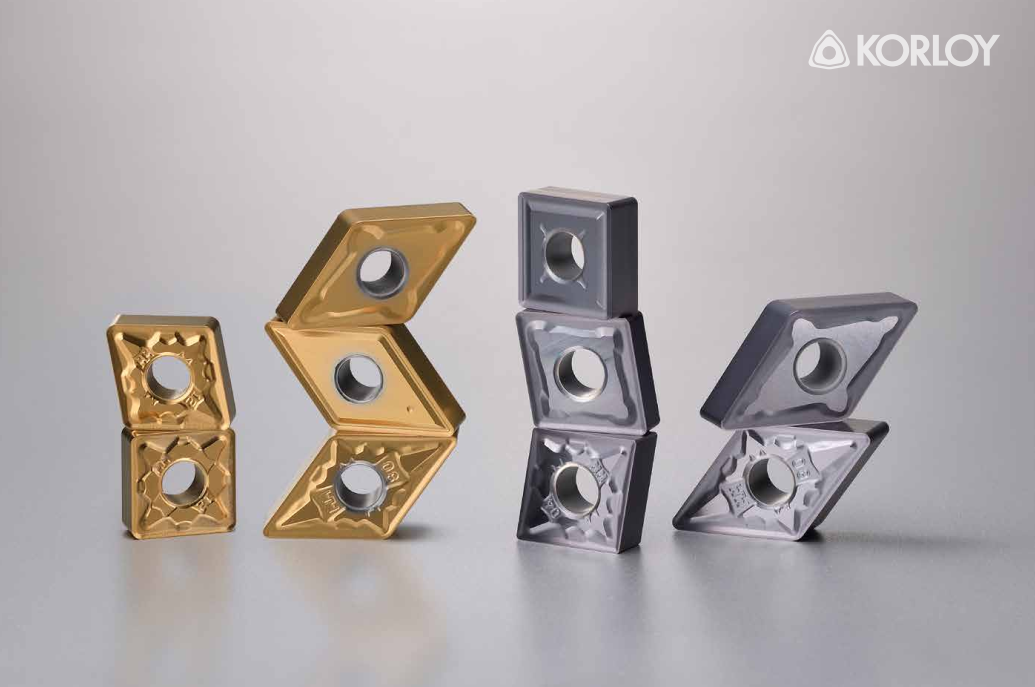
KORLOY’s Super grades (SNC805/SPC810) are recognized as products that achieved localization
in the machining of difficult-to-cut aerospace engine materials.
Relentless Pursuit of Technological Independence: CVD and PVD Coating Technologies
Coating technology marked one of the most significant turning points in KORLOY’s technological development. In its early years, the company had no proprietary CVD coating technology. At the time, KORLOY engineers were dispatched to its Japanese partner, Sumitomo, where they had to learn under highly restricted conditions. Despite strict security barriers, they persistently observed and analyzed every accessible process, ultimately laying the foundation for KORLOY’s own CVD coating and manufacturing technologies.
The development of KORLOY’s proprietary TiCN thin-film CVD coating for milling applications was equally challenging. Numerous coating trials resulted in repeated interfacial defects and abnormal film formation. After dozens of unsuccessful attempts, the team achieved success by redesigning both the substrate material and the coating recipe. This breakthrough led to the commercialization of the NCM25P grade, which contributed significantly to business growth.
The development of PVD thin-film technology was another continuous challenge. In the absence of mass-production equipment, KORLOY initiated industry-academia collaborative research and became the first company in Korea to independently design and build an HCD plasma-based PVD mass-production coating system. Although the equipment initially suffered from operational instability, engineers gradually replaced and optimized key components, eventually mastering both equipment control and process operation.
KORLOY later introduced one of the world's most advanced imported coating systems for further development. However, persistent coating delamination prevented stable mass production. After weeks of testing, engineers identified a simple contamination issue during the pre-treatment process as the root cause. Once corrected, this breakthrough enabled the successful development of the PC9030 coating and became a major turning point in expanding KORLOY’s PVD product business. Today, KORLOY’s coating technology stands as the result of years of perseverance, continuous experimentation, and technological innovation.
Built upon these achievements, KORLOY’s CVD turning product lineup has continued to evolve. Products such as the NC3200 series, combined with a wide range of turning chipbreakers, are widely used in automotive component manufacturing and general machining applications, earning strong market recognition.
In the PVD milling portfolio, grades such as PC5300, together with milling systems including Rich Mill, Alpha Mill, and HFM(D), represent KORLOY’s flagship solutions. These products are extensively applied in the mold & die, aerospace, energy, and defense industries.
Among KORLOY’s coated indexable drilling products, KING Drill and TPDB Plus are the leading solutions. KING Drill is highly regarded for maintaining excellent clamping rigidity under high-productivity machining conditions, while TPDB Plus delivers outstanding cost competitiveness, offering both high productivity and economic efficiency across machinery and equipment manufacturing.
Another noteworthy product is TP4P, a tangential-type milling cutter designed for 90-degree shoulder milling. Delivering stable and reliable performance even under unstable machining conditions, TP4P has recently attracted significant attention from customers.
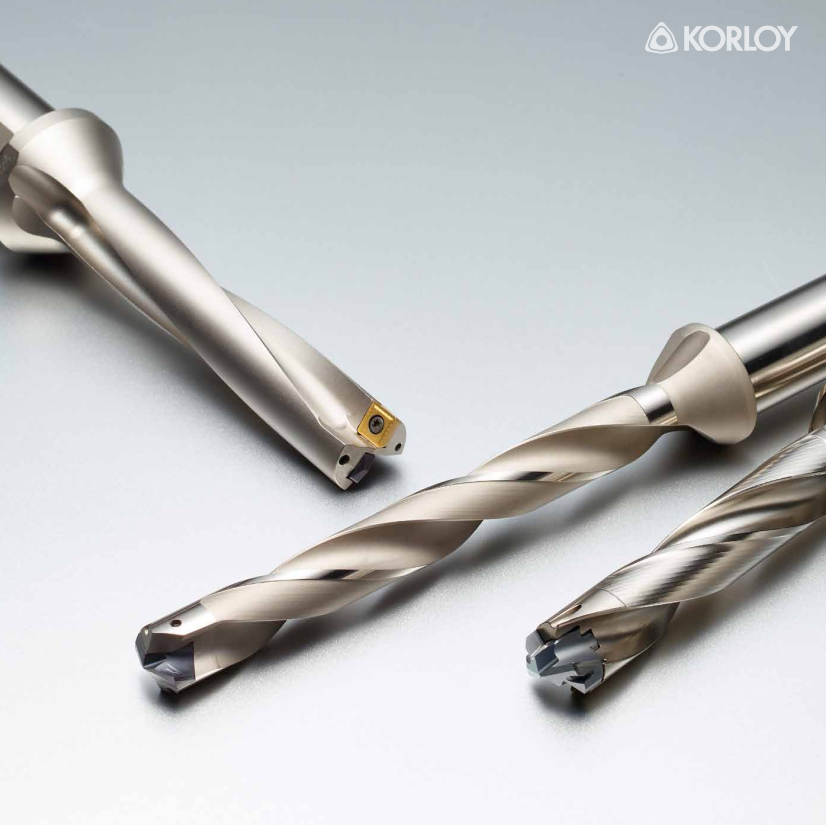
KORLOY's indexable drills: KING Drill, TPDB Plus, and TPDC Plus
The Three Pillars That Determine Tool Performance
The performance of a cutting tool is not determined by a single technology alone. KORLOY identifies three key factors that define tool performance and reliability: substrate strength, coating adhesion and wear resistance, and geometry precision. The integration and optimization of these three technologies is essential to developing high-performance cutting tools.
To achieve this, KORLOY is focusing on building core competitiveness in cemented carbide materials. From alloy design that maximizes wear resistance and strength to sintering process control that realizes an ideal microstructure, KORLOY continues to advance its material technologies through in-house expertise.
KORLOY has also established differentiated competitiveness in surface treatment technologies. Its PVD coatings suppress crack propagation through nano-multilayer structure control while improving delamination resistance and high-temperature hardness. Its CVD coatings deliver excellent wear resistance and tool life through next-generation alpha alumina (α-Al₂O₃) texture and MT-Ti(CN) control technologies. In addition, KORLOY’s diamond coating technology provides ultra-precision machining quality based on NCD and MCD control technologies specialized for machining zirconia and carbon fiber reinforced plastic (CFRP).
KORLOY also develops customized geometries optimized for workpiece materials and machining conditions by utilizing its accumulated chipbreaker design database and FEM simulation technology. This enables ideal chip control and stable machining conditions, ultimately contributing to higher customer productivity.
Going forward, KORLOY will continue to focus its capabilities on developing cutting tools with exceptionally high performance and reliability through integrated research into material, coating, and geometry technologies.
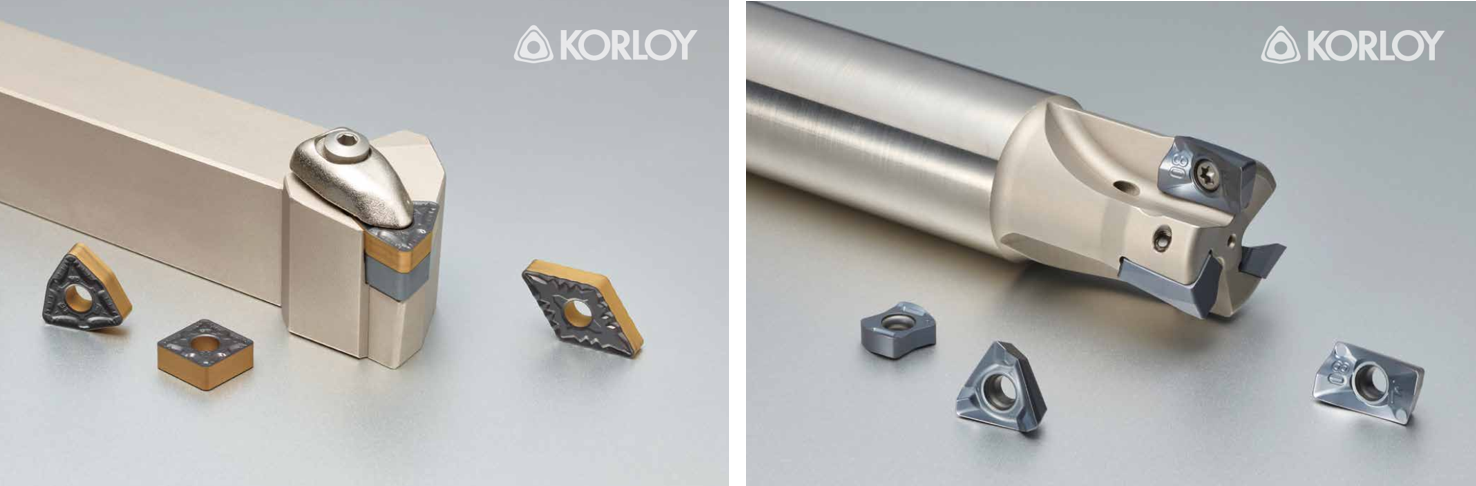
(Left) KORLOY's CVD insert, developed through proprietary coating and manufacturing technologies.
(Right) KORLOY's PVD insert, the result of relentless perseverance and continuous trial and error.
Changing Industries, Evolving Directions in Tool Development
The most significant recent changes in the cutting tool industry are shifts in workpiece materials and production environments. As electric vehicles become more widespread and the aerospace and defense industries continue to grow, demand for machining traditional steel and cast iron is declining, while demand for high-value difficult-to-cut materials such as titanium, Inconel, aluminum alloys, and CFRP is increasing.
The expansion of the aerospace and defense industries has a direct impact on the direction of tool development. To machine extremely difficult materials such as titanium, Inconel, and composites with stability, the development of special substrates, coatings, and geometries with ultra-high hardness and toughness is accelerating.
Demand is also increasing for special chipbreakers that suppress micro-vibration and high-pressure coolant tools, which are required to machine large monolithic structures and complex aerospace components with high precision.
The growing adoption of electric vehicles is also driving market change. As internal combustion engine and transmission components decrease, demand for cutting ferrous materials is declining. At the same time, demand for machining aluminum alloys and CFRP for vehicle lightweighting is increasing. Demand for tools used in machining EV components such as electric motor housings and reduction gears is also expected to grow.
Meanwhile, raw material supply chain risks are emerging as an important variable in the cutting tool industry. In response to rising prices and possible export restrictions on rare metals such as tungsten carbide (WC) and cobalt (Co), the development of alternative alloys, next-generation cermets, smaller inserts, indexable alternatives to solid tools, and multi-corner inserts is becoming increasingly important. Recycling used tools and establishing resource-circulating manufacturing systems are also expected to become key future tasks.
To respond to these market changes, KORLOY is concentrating its R&D capabilities on securing next-generation difficult-to-cut material machining technologies. In particular, for high-difficulty materials such as titanium and Inconel required in the aerospace and defense industries, KORLOY is focusing on the development of next-generation ultra-tough and ultra-hard substrates based on new alloy designs.
Through this approach, KORLOY aims to secure stable tool life and machining performance even under the high cutting heat and severe wear conditions that occur during difficult-to-cut material machining.
KORLOY is also actively developing proprietary next-generation CVD and PVD coating technologies by utilizing nanometer-level material structure and composition control. These advanced coating technologies improve heat resistance and wear resistance in high-temperature environments while providing excellent lubrication properties, enabling effective control of friction and heat during difficult-to-cut material machining.
In addition, KORLOY is strengthening high-pressure coolant technology and special insert geometry design to solve chip formation and chip evacuation issues that frequently occur in difficult-to-cut material machining. By applying dedicated chipbreakers and cutting geometries optimized for each material, KORLOY expects to improve chip control and machining stability while contributing to higher customer productivity and process efficiency.
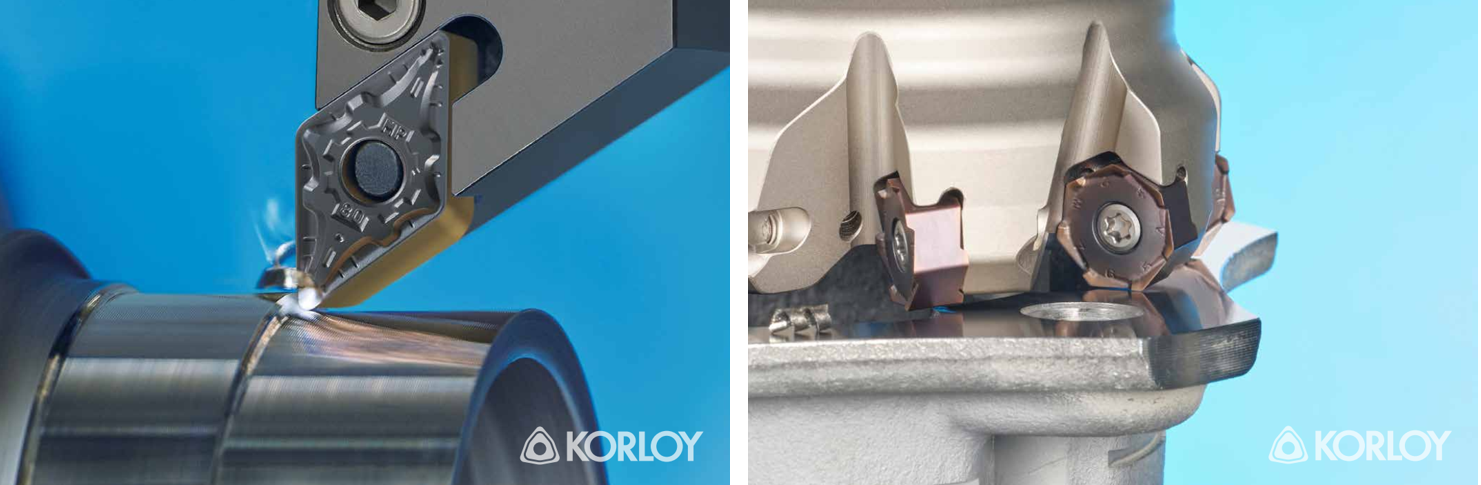
(Left) KORLOY CVD Insert (NC3200 Series), (Right) KORLOY PVD Insert (PC6100)
Digital Technology and AI Are Changing the Speed of Tool Development
KORLOY actively utilizes simulation and data analysis technologies throughout its product development process. In the tool geometry design stage, chip cutting force analysis, stress, temperature distribution, chip evacuation behavior, vibration analysis, and flow analysis are verified in advance through CAE simulation. This improves design completeness before actual production and reduces trial and error during development.
In material development and coating technologies, KORLOY analyzes sintering conditions, microstructural characteristics, and coating process data to minimize quality variation and identify optimal conditions.The company is also accumulating cutting performance evaluation data into a comprehensive database, expanding them into database systems for geometry equipment and workpiece material management, evaluation condition optimization, and reliability improvement.
Going forward, KORLOY plans to expand these efforts into AI-based tool life prediction and optimal machining condition recommendation technologies. In actual cutting tool applications, smart toolholders equipped with sensors can collect and analyze vibration, temperature, and machining load data in real time. This allows AI to diagnose tool wear and predict breakage in advance, reducing unexpected machine downtime and improving the stability of unmanned machining.
AI also holds great potential in the R&D stage. By running numerous simulations in a virtual environment to verify substrates, thin films, and product designs, development time can be shortened. AI is also expected to support prior-art patent and technical data analysis, helping not only to reduce time but also to generate creative ideas.
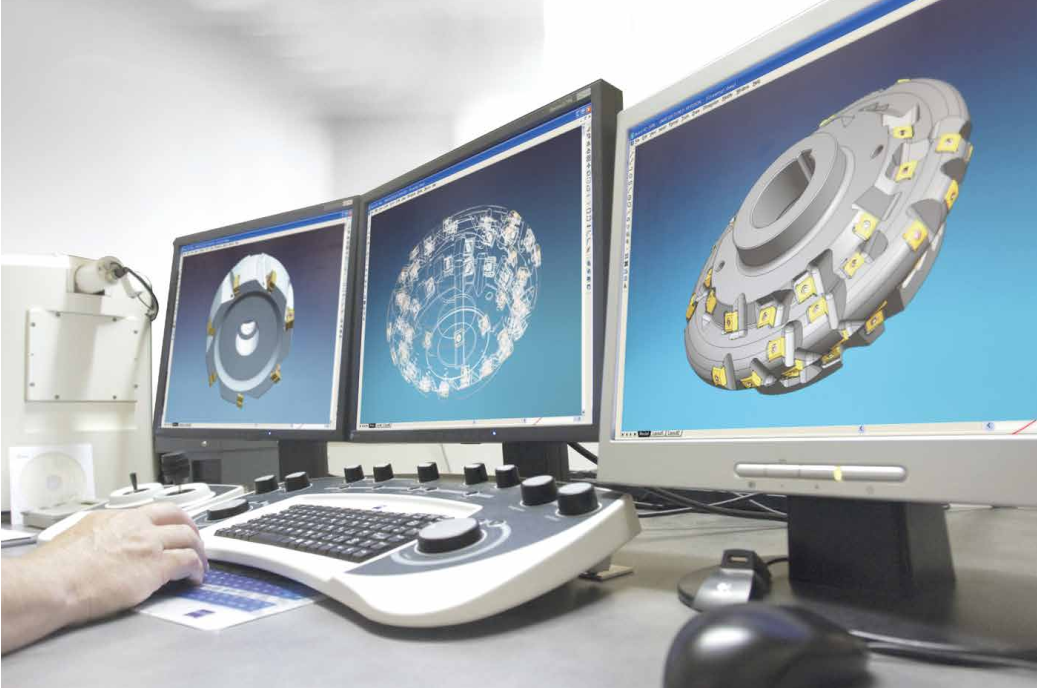
KORLOY actively utilizes simulation and data analysis technologies throughout its product development process.
During the tool geometry design stage, designs are validated through CAE simulation.
R&D Begins with the Voice of the Customer
KORLOY’s R&D Division stated, “The most important principle in KORLOY’s product development is our Market-in quality philosophy: starting with the voice of the customer, validating through data that replicates actual machining conditions, and ultimately delivering customer value.”
Product development begins with preliminary research that gathers customer requirements and defines customer challenges. The collected requirements and issues are translated into specific evaluation methods so they can be reproduced in KORLOY’s in-house performance evaluation laboratory. Upon completion of development, these evaluation methods are used to rigorously verify whether the original issues have been fully resolved. In other words, customer requirements serve as the standard that guides the entire development process—from the initial concept to final product approval.
Close collaboration between the R&D Center and the sales and technical support organizations is also essential. During the early development stage, the sales and technical support teams collect customer requirements. Before official product launch, customer evaluations of new products are conducted. During the initial launch period, technical support works together with sales to provide customer assistance and product promotion. This collaborative process continues from product planning through successful market introduction.
When selecting R&D projects, KORLOY considers the likelihood of success as the most important criterion. Projects with high potential for success not only provide differentiated value and competitiveness to customers but also directly contribute to the company's profitability and future growth. At the same time, rapid responses to product lines with weak cost competitiveness, development of products for strategic industries, and strengthening product portfolios for future growth industries are also key considerations.
KORLOY’s Distinctive Technology Management
CEO Junghyun Yim of KORLOY stated, “Technology management is about continuously investing in R&D to bring distinctive products to the market that differentiate us from our competitors. Providing differentiated products and services to customers while expanding into high value-added industries is the essence of our technology management.”
Over the past 60 years, KORLOY has accumulated expertise in cemented carbide materials, coatings, chipbreakers, precision engineering, and mass production technologies. Today, those technologies are expanding into new challenges, including difficult-to-cut materials, ultra-precision machining, data-driven technologies, AI, and environmentally sustainable manufacturing.
CEO Junghyun Yim added, “Developing cutting tools ultimately means understanding our customers’ manufacturing processes. Improving customer productivity, stabilizing quality, and reducing manufacturing costs—these are the values that KORLOY’s products and technologies have consistently delivered and will continue to pursue as the core of our technology management.”